AICHI HANSA W.33 by Chema Martinez “From the North Sea to the Rising Sun” Designed by Ernst Heinkel one evening on the back of a cabaret wine list, the Hansa-Brandenburg W.29 was essentially an evolved version of the earlier W.12. With improved performance — thanks to reduced drag from a 50% wing reduction — it owed its strength to the rigid float and strut layout. It proved to be a worthy successor to the W.12 in its role of patrolling the North Sea and harassing RNAS seaplanes and British surface vessels. The aircraft later reached Japan as the *Hansa-Shiki Suijo Teisatsuki* — Navy Type Hansa Reconnaissance Seaplane — with between 156 and 310 units produced. It was powered by a Mitsubishi Type Hi (a licensed Hispano-Suiza) V-12, liquid-cooled engine generating between 170 and 210 HP. The “Navy Type Hansa” was built based on the Hansa-Brandenburg W.33, which Japan had received from Germany as part of its post–World War I reparation quota. The modifications to the original design were carried out by Nakajima, while the construction was shared between Nakajima and Aichi. By 1922, the Imperial Japanese Navy had decided to adopt this aircraft for series production. The original design by Dr. Ernst Heinkel was considered structurally advanced and delivered excellent performance. To better meet Japanese operational requirements, several changes were made in the domestic production versions. By 1922, the Imperial Japanese Navy had decided to adopt this aircraft for series production. The original design by Dr. Ernst Heinkel was considered structurally advanced and delivered excellent performance. To better meet Japanese operational requirements, several changes were made in the domestic production versions. Pilots, however, were not particularly fond of the Hansa, criticizing its handling, poor directional control, and limited visibility, among other shortcomings. These aircraft were the first reconnaissance seaplanes carried aboard the battleship *Nagato*, starting in 1926. Many remained in service until around 1927–1928, when they were replaced by the Yokosho and Nakajima Type 14 and Type 15 reconnaissance seaplanes. Once retired, some surplus Hansas were converted into single-passenger civilian transports by Japan Air Transport Research. The Idea: This model was built using the Wingnut Wings 1/32 Hansa-Brandenburg as a base. I reworked the entire nose section and replaced the engine with a 1/32 Roden Hispano-Suiza. The wings also feature several modifications. My original plan was to build one of the German versions offered in the kit, but while researching online, I noticed that all models of this aircraft looked surprisingly similar. That led me to search for something different. I discovered a Finnish version fitted with skis — in similar colors — and a Japanese version in white. The Japanese one instantly captivated me. Though information was scarce, I found enough to bring it to life. I knew the work ahead would be demanding but exciting: rebuilding the front section, replacing the engine, creating homemade stencils for the markings — all the perfect challenges to keep my enthusiasm high. AICHI HANSA W.33 AICHI HANSA W.33 by Chema Martinez AICHI HANSA W.33 by Chema Martinez AICHI HANSA W.33 by Chema Martinez AICHI HANSA W.33 by Chema Martinez AICHI HANSA W.33 by Chema Martinez “Sometimes, chasing a lesser-known story gives life to a model that feels truly unique — that’s where passion meets history.” — Chema M.
FE.2B EARLY
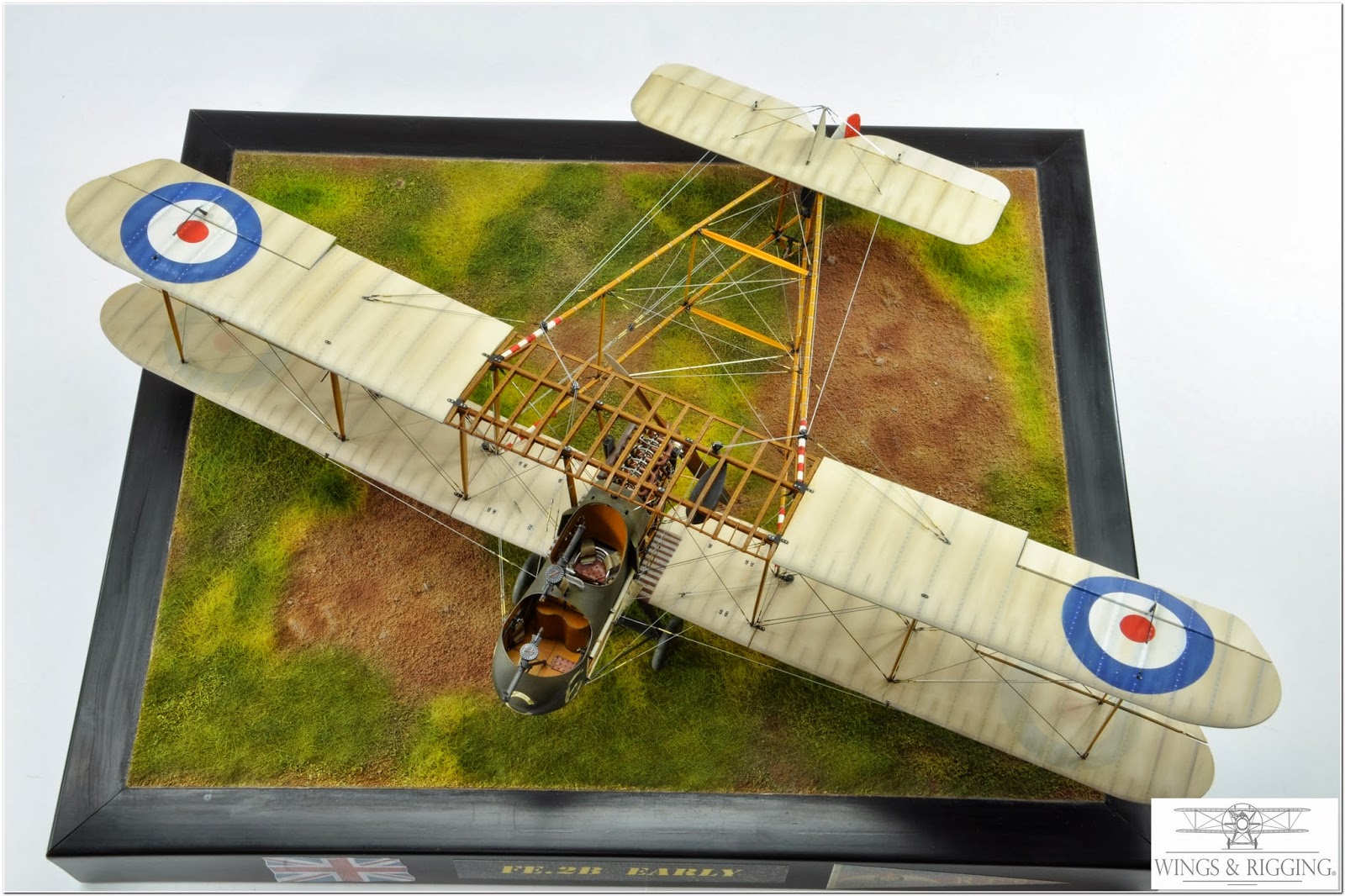
FE.2B EARLY by Chema Martinez “The Project That Took Flight” This project first began to take shape during my very first visit to Scale Model World Telford in 2011. While wandering among the countless stands, I came across a couple of truly amazing books about this aircraft. As a WWI enthusiast and follower of the Wingnut Wings brand, I had already heard rumors that they were planning to release this model — so, the moment I saw those books, it was clear what my next project would be. A little over a month after returning from Telford, the New Zealand company launched the kit in two different versions: Early and Late. Unable to choose between them, I decided to buy both. That’s when this project began — one that, without a doubt, has tested every one of my modeling skills. The Project: Once the two kits were in my hands, I sat down comfortably on the sofa to enjoy and study both. The first step was to choose which aircraft to build. I went through all the markings and schemes from both versions, and since I felt like building a linen-colored aircraft, the Early version was the one. With the choice made, it was time to plan the build. Following the same approach as in my recent Wingnut Wings projects — and given the outstanding detail of both the interior and the engine — I decided that these two elements would be the main focus of this build. FE.2B EARLY by Chema Martinez FE.2B EARLY by Chema Martinez FE.2B EARLY by Chema Martinez FE.2B EARLY by Chema Martinez FE.2B EARLY by Chema Martinez FE.2B EARLY by Chema Martinez “Some projects begin as ideas, but end up becoming journeys — this one truly made me fly further as a modeler.” — Chema M.

BRISTOL F2B “THE CROCODILE”
BRISTOL F2B – “THE CROCODILE” “Inside the Spirit of a Great War Machine” For the foundation of this project, I used the Wingnut Wings 1/32 scale kit. The idea was to show an aircraft from that era from the inside. It has been a truly complex but fascinating job because of its difficulty — without a doubt, one of my greatest modeling challenges, from which I’ve learned an enormous amount for future projects. BRISTOL F2B – “THE CROCODILE” BRISTOL F2B – “THE CROCODILE” BRISTOL F2B – “THE CROCODILE” BRISTOL F2B – “THE CROCODILE” BRISTOL F2B – “THE CROCODILE” BRISTOL F2B – “THE CROCODILE” “This work was awarded the gold medal for Best 1/32 WWI Aircraft at Scale Model World Telford 2013.” — Chema M.
FOKKER Dr.I LOTHAR VON RICHTHOFEN
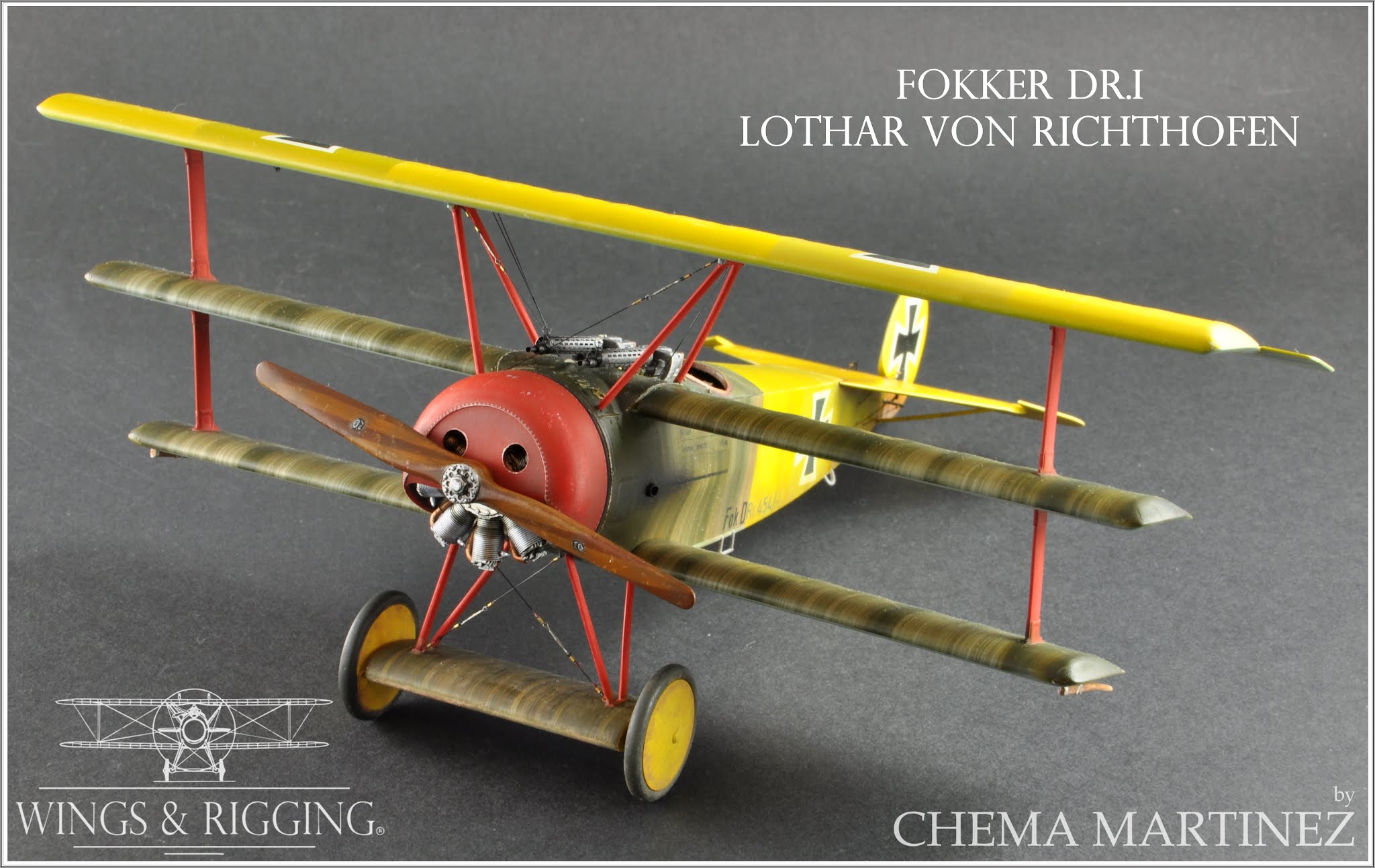
FOKKER Dr.I LOTHAR VON RICHTHOFEN “A Different Shade of History” A 1/32 scale model built from a kit that’s already more than a decade old. It was great fun to assemble, and I really enjoyed enhancing it both from scratch and with added details in photo-etch, resin, and 3D-printed parts. The painting process was quite a challenge, combining traditional paintwork with decals in some areas of the camouflage. Yellow is not the easiest color to handle, but I’m very pleased with the final result. The crosses were painted using masks, which gives the model a more realistic finish. I chose this particular scheme to step away from the Baron’s typical red and do something different. Even so, his famous red triplane remains on my list of future projects — a small tribute I’d love to create. Hope you like my version of this aircraft. FOKKER Dr.I LOTHAR VON RICHTHOFEN FOKKER Dr.I LOTHAR VON RICHTHOFEN FOKKER Dr.I LOTHAR VON RICHTHOFEN FOKKER Dr.I LOTHAR VON RICHTHOFEN FOKKER Dr.I LOTHAR VON RICHTHOFEN “I chose this particular scheme to step away from the Baron’s typical red and do something different” — Chema M.
Spanish Air Force Award 2024: the Caudron G.III
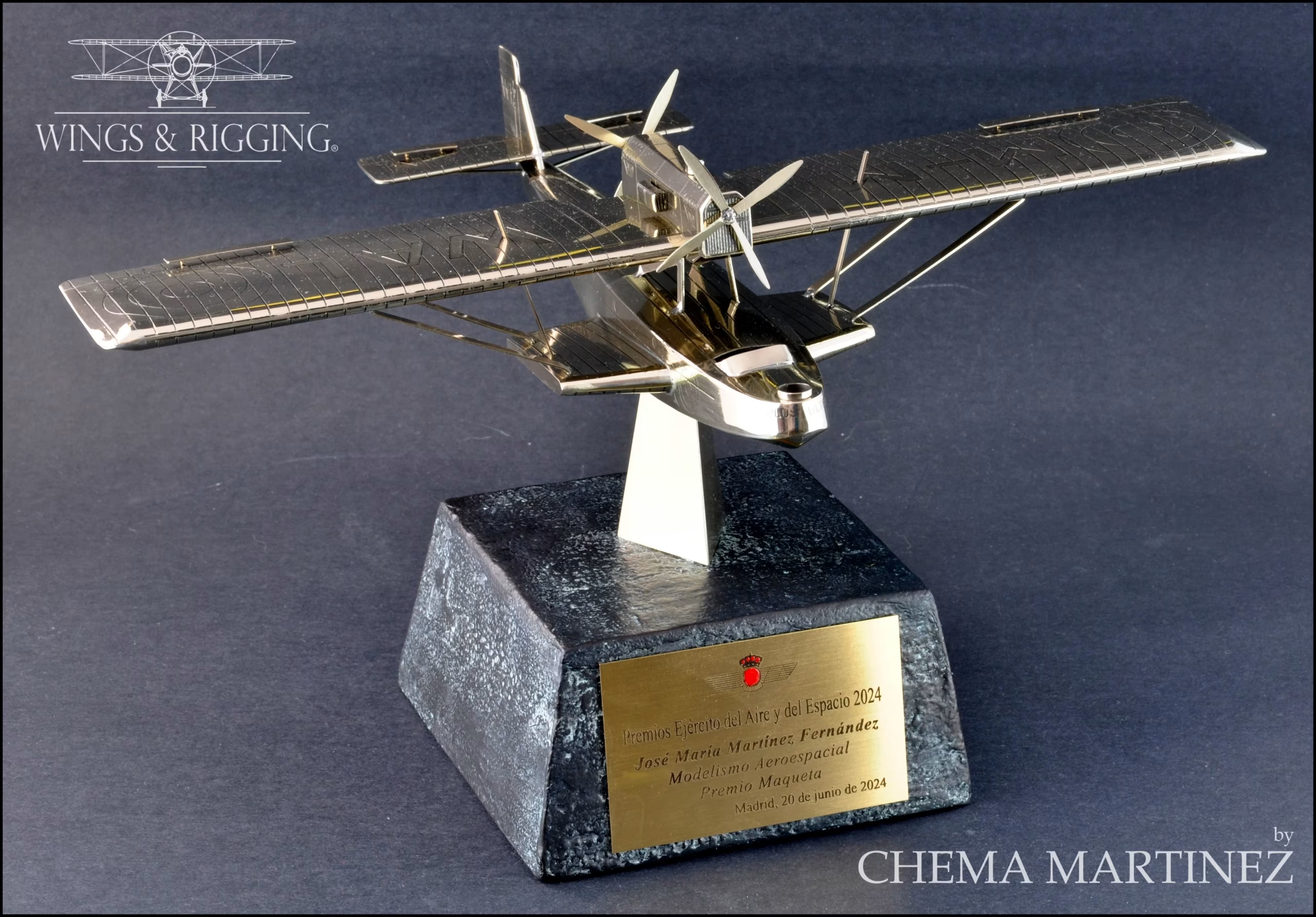
CAUDRON G.III “A tribute in scale — honoring the Caudron that trained a generation of Spanish aviators.” A tribute to the 100 officers selected in February 1920 to undergo pilot training on Caudron G.III aircraft at elementary aviation schools such as Cuatro Vientos, Getafe, and Seville. This 1/32 scale plastic kit from Copper State Models has been meticulously refined with the addition of metal turnbuckles from Gaspach Models and an engine adapted using metal rods and copper wiring. The cockpit was scratch‑built and reconfigured into a dual‑control layout to reflect its use in training. Furthermore, the wings were modified to accurately represent the variant that served in the Spanish Air Force. CAUDRON G.III CAUDRON G.III CAUDRON G.III CAUDRON G.III CAUDRON G.III CAUDRON G.III “Each part of this model preserves the memory of those who learned to fly in it.” — Chema M.