Felixstowe F.2a – Interior This large flying boat is my recommendation If you are looking for a truly demanding challenge in aircraft scale modeling, this large flying boat is my recommendation. The Felixstowe F.2a was one of the greatest challenges I have ever faced, mainly due to its large size. I decided to leave the upper section open, as the interior details are truly spectacular. I carried out several painting tests on the wings until I developed a new technique that successfully replicated the linen-covered fabric, adding a high level of realism. I also experimented with new products on the hull to reproduce the weathering caused by constant exposure to the sea. The sheer number of rigging wires, struts, and attachment points required between the wing connections exceeded 200 individual elements, making the rigging phase particularly demanding. There are many references about this aircraft but this Felixstowe F.2a was the most successful flying boat of the First World War, operated by a five-man crew for long-range reconnaissance, anti-submarine, and anti-shipping missions lasting up to ten hours. Its design evolved from the pre-war Anglo-American Curtiss “America” flying boat, progressively improved by Glenn Curtiss and Cyril Porte. By 1917, Porte developed the distinctive deep V-shaped hull that defined the Felixstowe series, developed at the RNAS Seaplane Experimental Station in Felixstowe. Powered by twin Rolls-Royce Eagle VIII engines, the F.2a featured advanced boat-style construction and underwent multiple refinements, including changes to cockpit configuration, control surfaces, and hull strengthening. Variants included the American-built Curtiss H.16 with Liberty engines. Related models such as the larger F.3 and F.5 were produced but were generally considered inferior, with the F.5 arriving too late for wartime service. Felixstowe flying boats were typically finished with dark-painted upper wings, clear-doped linen undersurfaces, and black bituminous waterproofing on hull areas and fittings. These aircraft often weathered quickly in maritime conditions, and from mid-1918 some were painted in brightly colored dazzle schemes for identification. Felixstowe Felixstowe F.2a – Interior “Felixstowe F.2a was the most successful flying boat of the First World War” — Chema M. Lorem ipsum dolor sit amet, consectetur adipiscing elit. Ut elit tellus, luctus nec ullamcorper mattis, pulvinar dapibus leo.

R.A.F. SE.5a HISSO
R.A.F. SE.5a Hisso by Chema Martinez A VETERAN OF THE GREAT WAR IN SPAIN At the end of the Great War, surplus aircraft were handed over to Aircraft Disposal, from which the Spanish Military Aeronautics is believed to have purchased one example — although some sources suggest that two may have entered service — around 1919, when a wave of second-hand aircraft arrived in Spain. There is little documented information about this particular airplane and its operational service, but it officially entered service with the Spanish Army Air Corps in 1919. On its fuselage sides, the aircraft sported a witch riding a broomstick — it is not clear whether this was a personal emblem or the marking of a specific unit. What is known is that a nearly identical witch motif also appeared on a Breguet XIV. The model includes a figure of a Spanish pilot wearing a 1919 flight suit, based on an illustration by artist Delfín Salas. R.A.F. SE.5a Hisso by Chema Martinez R.A.F. SE.5a Hisso by Chema Martinez R.A.F. SE.5a Hisso by Chema Martinez R.A.F. SE.5a Hisso by Chema Martinez “Some aircraft may grow old, but their stories still carry the wind of the skies they once conquered.” — Chema M.
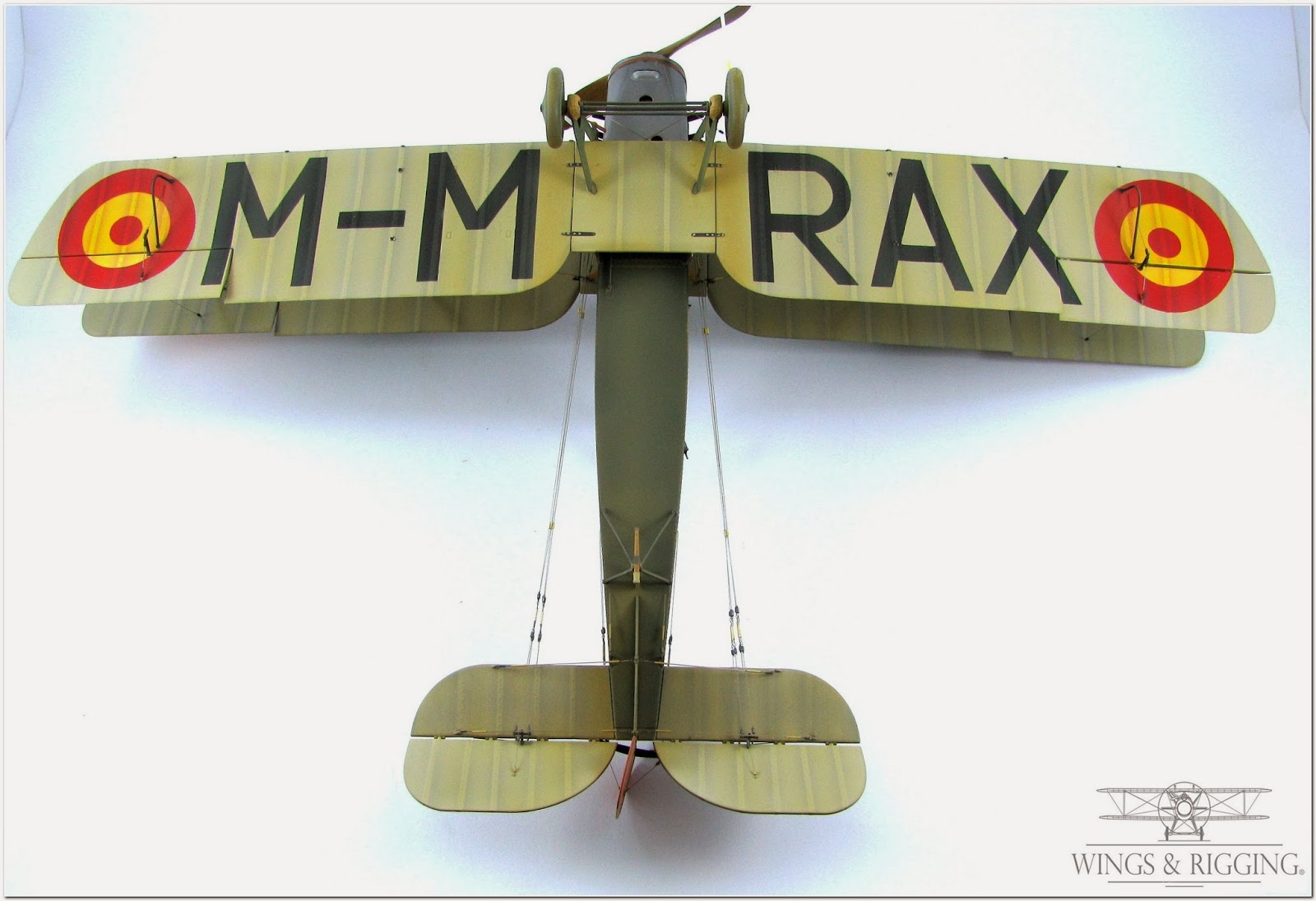
BRISTOL F.2B – FIRST SQUADRON
BRISTOL F.2B by Chema Martinez “In Memory of Those Who Never Returned” This is one of my latest completed project, built entirely from plans — 100% scratch. Without a doubt, it has been my greatest moBristol F.2B 1/32 by Wingnut Wings, with a fully reworked engine section and a Roden engine replacement. In memory of Lieutenant Juan Moneo and Sergeant Jesús Cartagena. This Bristol F.2B belonged to the First Squadron and was based at the Tauima airfield in 1925. It was flown by Lieutenant Juan Moneo, with Sergeant Jesús Cartagena serving as the bomber. In the early morning of April 19th, 1925, several aircraft took off from Tauima airfield to fly over the rebel market taking place in Benibuyari del Llano. The aviators descended to low altitude and strafed numerous tribesmen, forcing them to flee. Aircraft M-MRAX B-24, piloted by Lieutenant Moneo with Sergeant Cartagena as bombardier, pursued a group of rebels, engaging them with machine-gun fire. However, a concentrated burst from enemy rifles seriously wounded both men. The aircraft, now out of control, entered a spin and crashed violently into a nearby ravine. Both aviators likely died on impact. In a rescue attempt, forces from the *Harca de Vareja* advanced into hostile territory—about three kilometers from the position at Azib de Midar—recovering the bodies of the fallen. Unable to retrieve the aircraft, they set it on fire to prevent its capture. Other pilots flew overhead, dropping bombs to keep the rebels at a distance. The bodies were brought to the Red Cross hospital, where their comrades kept vigil through the night. Lieutenant Moneo was a close friend of Lieutenant Muñoz, who had died in the same area just days earlier, under similar circumstances. Upon learning of the tragedy, the airfield commander, Fernández, and Lieutenant Lastra flew immediately to Azib de Midar. BRISTOL F.2B by Chema Martinez BRISTOL F.2B by Chema Martinez BRISTOL F.2B by Chema Martinez BRISTOL F.2B by Chema Martinez BRISTOL F.2B by Chema Martinez BRISTOL F.2B by Chema Martinez “Their wings fell before their courage did — may this model keep alive the memory of those who gave everything in the skies of Tauima.” — Chema M.

LVG C.VI
LVG C.VI by Chema Martinez “The Silent Eyes of the Western Front” The LVG C.VI was a reconnaissance aircraft built by Luftverkehrsgesellschaft in 1917 — the company from which its initials derive. The aircraft was designed by Willy Sabersky-Müssigbrodt. Developed from the earlier C.V model, the C.VI was lighter, smaller, and more refined, even though its fuselage appeared more solid. It was a biplane built mostly of mixed wood construction; the fuselage used a semi-monocoque plywood skin. The rectangular wings were made of wood and metal and covered with fabric. The upper wing had a slightly greater span than the lower one, and the fin was plywood-covered wood, while the rudder and elevators were wooden framed and fabric-covered. It was powered by a six-cylinder Benz Bz.IV water-cooled engine producing 200 hp, giving it a top speed of 170 km/h and a service ceiling of 6,500 meters. The engine radiator was mounted in the central section of the upper wing. Armament consisted of two machine guns — one fixed Spandau LMG 08/15 and, depending on the version, either a Parabellum LMG 14/17 or a Parabellum LMG 14 mounted on a flexible ring for the observer. It featured a fixed landing gear and a tailskid. The aircraft was equipped with a Morse radio that could only transmit, using an antenna deployed beneath the fuselage. The crew carried parachutes and special cold-weather flight suits. A total of around 1,100 units were built. Most LVG aircraft were used by the German Air Service during the final operations of the First World War, especially on the Western Front, for reconnaissance and artillery spotting. The Model: The kit is by Wingnut Wings in 1/32 scale, and its quality is simply outstanding. The level of detail is superb. It includes a total of 166 plastic parts spread across seven sprues — one of them clear — each individually bagged to prevent friction. The kit also includes a photo-etched sheet for the seatbelts and four Cartograf decal sheets with *lozenge* patterns and markings for seven different aircraft. It only lacks a photo-etched part to simulate the cooling jackets of the machine guns, but apart from that, it’s an excellent, highly detailed kit with great potential for realistic finishes. LVG C.VI by Chema Martinez LVG C.VI by Chema Martinez LVG C.VI by Chema Martinez LVG C.VI by Chema Martinez LVG C.VI by Chema Martinez “Built for observation and endurance, the LVG C.VI reminds us that not all heroes in the sky carried bombs — some carried only their eyes and their courage.” — Chema M.

AICHI HANSA W.33
AICHI HANSA W.33 by Chema Martinez “From the North Sea to the Rising Sun” Designed by Ernst Heinkel one evening on the back of a cabaret wine list, the Hansa-Brandenburg W.29 was essentially an evolved version of the earlier W.12. With improved performance — thanks to reduced drag from a 50% wing reduction — it owed its strength to the rigid float and strut layout. It proved to be a worthy successor to the W.12 in its role of patrolling the North Sea and harassing RNAS seaplanes and British surface vessels. The aircraft later reached Japan as the *Hansa-Shiki Suijo Teisatsuki* — Navy Type Hansa Reconnaissance Seaplane — with between 156 and 310 units produced. It was powered by a Mitsubishi Type Hi (a licensed Hispano-Suiza) V-12, liquid-cooled engine generating between 170 and 210 HP. The “Navy Type Hansa” was built based on the Hansa-Brandenburg W.33, which Japan had received from Germany as part of its post–World War I reparation quota. The modifications to the original design were carried out by Nakajima, while the construction was shared between Nakajima and Aichi. By 1922, the Imperial Japanese Navy had decided to adopt this aircraft for series production. The original design by Dr. Ernst Heinkel was considered structurally advanced and delivered excellent performance. To better meet Japanese operational requirements, several changes were made in the domestic production versions. By 1922, the Imperial Japanese Navy had decided to adopt this aircraft for series production. The original design by Dr. Ernst Heinkel was considered structurally advanced and delivered excellent performance. To better meet Japanese operational requirements, several changes were made in the domestic production versions. Pilots, however, were not particularly fond of the Hansa, criticizing its handling, poor directional control, and limited visibility, among other shortcomings. These aircraft were the first reconnaissance seaplanes carried aboard the battleship *Nagato*, starting in 1926. Many remained in service until around 1927–1928, when they were replaced by the Yokosho and Nakajima Type 14 and Type 15 reconnaissance seaplanes. Once retired, some surplus Hansas were converted into single-passenger civilian transports by Japan Air Transport Research. The Idea: This model was built using the Wingnut Wings 1/32 Hansa-Brandenburg as a base. I reworked the entire nose section and replaced the engine with a 1/32 Roden Hispano-Suiza. The wings also feature several modifications. My original plan was to build one of the German versions offered in the kit, but while researching online, I noticed that all models of this aircraft looked surprisingly similar. That led me to search for something different. I discovered a Finnish version fitted with skis — in similar colors — and a Japanese version in white. The Japanese one instantly captivated me. Though information was scarce, I found enough to bring it to life. I knew the work ahead would be demanding but exciting: rebuilding the front section, replacing the engine, creating homemade stencils for the markings — all the perfect challenges to keep my enthusiasm high. AICHI HANSA W.33 AICHI HANSA W.33 by Chema Martinez AICHI HANSA W.33 by Chema Martinez AICHI HANSA W.33 by Chema Martinez AICHI HANSA W.33 by Chema Martinez AICHI HANSA W.33 by Chema Martinez “Sometimes, chasing a lesser-known story gives life to a model that feels truly unique — that’s where passion meets history.” — Chema M.

RE.8 HARRY TATE
RE.8 HARRY TATE by Chema Martinez “The Eyes of the Great War” The RE.8 was a British two-seat biplane used for reconnaissance and bombing missions during the First World War. It was designed by John Kenworthy to replace the more vulnerable BE2. The RE.8, however, proved harder to fly, and at first, it was met with reluctance by the Royal Flying Corps. Although it eventually provided reasonably satisfactory service, it was never considered an outstanding combat aircraft. Despite its limitations, the RE.8 became the standard British reconnaissance and artillery observation aircraft from mid-1917 until the end of the war. More than 4,000 units were produced, serving in nearly all theatres — including Italy, Russia, Palestine, Mesopotamia, and, of course, the Western Front. The Model: This 1/32 scale model by Wingnut Wings is, as usual for the brand, a superb kit with exceptional attention to detail. It offers five different marking options and consists of 295 plastic parts and 15 photo-etched pieces. The engine itself is a miniature model, beautifully designed, and the instruction manual — complete with clear photos — guides the build perfectly step by step. RE.8 HARRY TATE by Chema Martinez RE.8 HARRY TATE by Chema Martinez RE.8 HARRY TATE by Chema Martinez RE.8 HARRY TATE by Chema Martinez RE.8 HARRY TATE by Chema Martinez RE.8 HARRY TATE by Chema Martinez “Some aircraft may not have shined in combat, but they carried the silent duty of observation — and that, too, deserves to be remembered.” — Chema M.
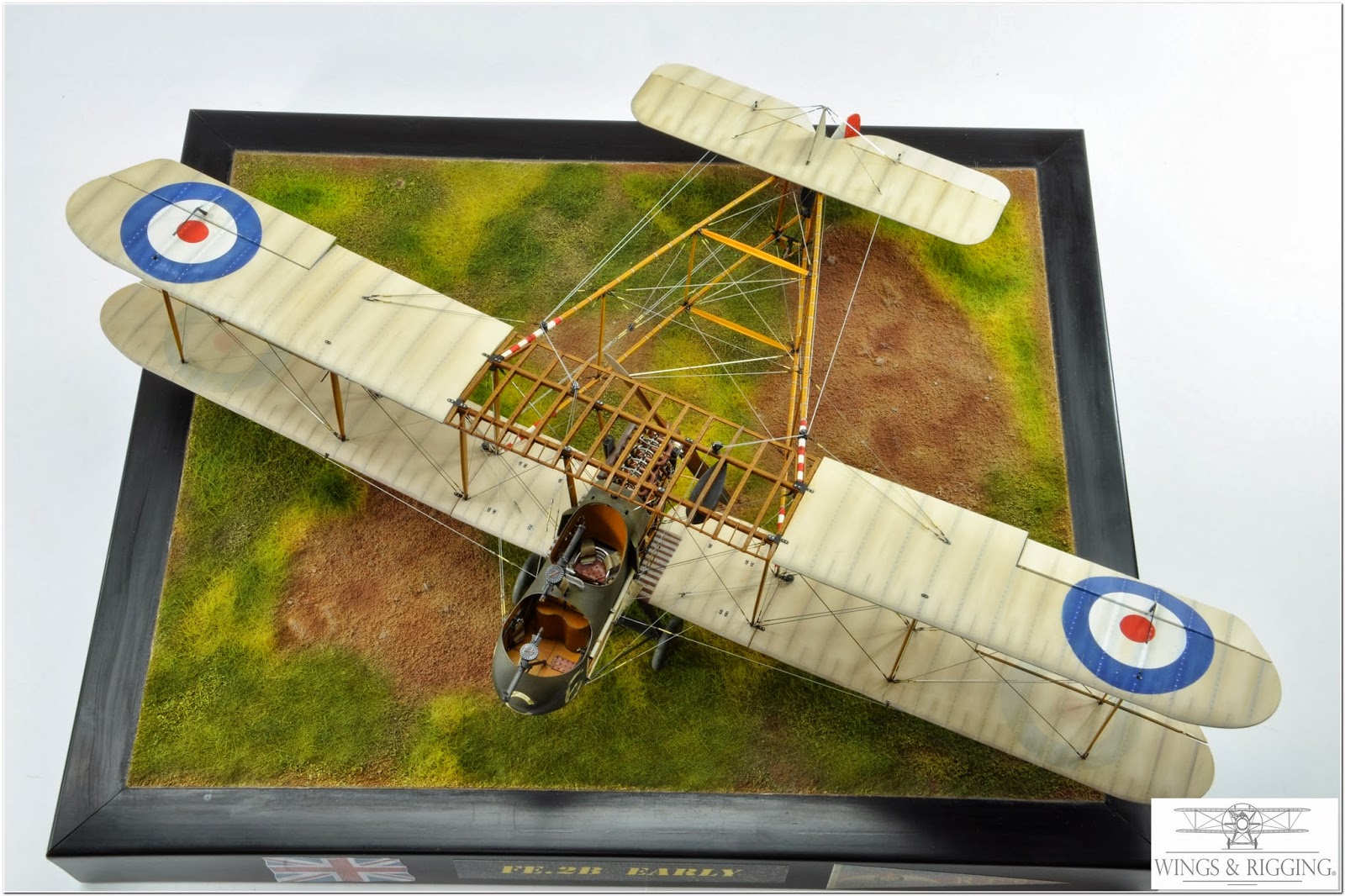
FE.2B EARLY
FE.2B EARLY by Chema Martinez “The Project That Took Flight” This project first began to take shape during my very first visit to Scale Model World Telford in 2011. While wandering among the countless stands, I came across a couple of truly amazing books about this aircraft. As a WWI enthusiast and follower of the Wingnut Wings brand, I had already heard rumors that they were planning to release this model — so, the moment I saw those books, it was clear what my next project would be. A little over a month after returning from Telford, the New Zealand company launched the kit in two different versions: Early and Late. Unable to choose between them, I decided to buy both. That’s when this project began — one that, without a doubt, has tested every one of my modeling skills. The Project: Once the two kits were in my hands, I sat down comfortably on the sofa to enjoy and study both. The first step was to choose which aircraft to build. I went through all the markings and schemes from both versions, and since I felt like building a linen-colored aircraft, the Early version was the one. With the choice made, it was time to plan the build. Following the same approach as in my recent Wingnut Wings projects — and given the outstanding detail of both the interior and the engine — I decided that these two elements would be the main focus of this build. FE.2B EARLY by Chema Martinez FE.2B EARLY by Chema Martinez FE.2B EARLY by Chema Martinez FE.2B EARLY by Chema Martinez FE.2B EARLY by Chema Martinez FE.2B EARLY by Chema Martinez “Some projects begin as ideas, but end up becoming journeys — this one truly made me fly further as a modeler.” — Chema M.

LOHNER Type L, 1/32 – 100% Scratchbuilt
LOHNER Type L by Chema Martinez “From Plans to Wings” This is one of my latest completed project, built entirely from plans — 100% scratch. Without a doubt, it has been my greatest modeling challenge so far, a truly fascinating journey that I’ll surely repeat with other aircraft. Hope you like it. LOHNER Type L by Chema Martinez LOHNER Type L by Chema Martinez LOHNER Type L by Chema Martinez LOHNER Type L by Chema Martinez LOHNER Type L by Chema Martinez LOHNER Type L by Chema Martinez “Creating from nothing is the closest way to understand how these machines once came to life.” — Chema M.
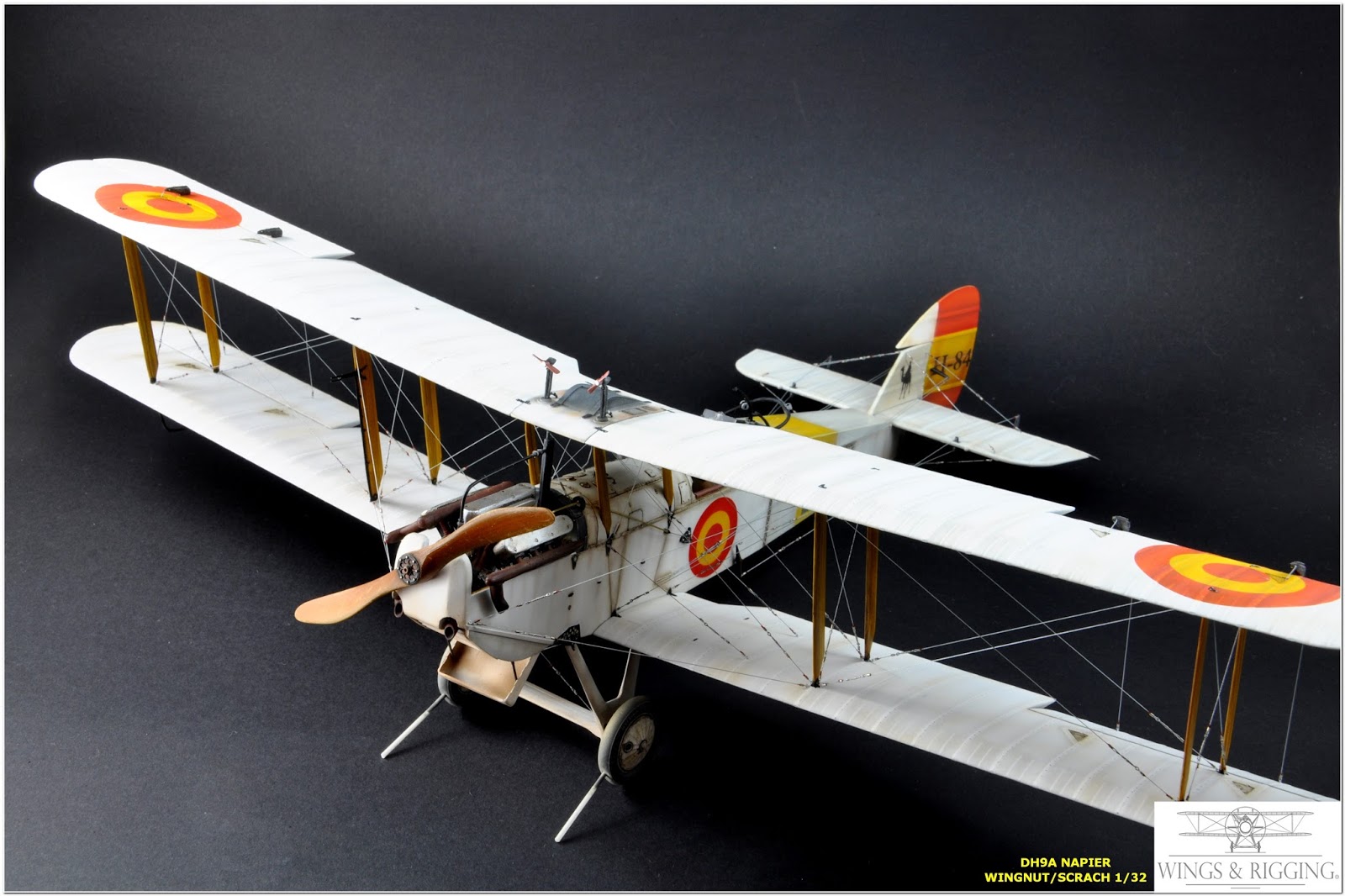
DH9A NAPIER 1/32
DH9A NAPIER 1/32 “You Shall Go and Return” DH.9A from the Sahara Squadron. Note on the tail the camel, the unit’s emblem, which operated in the Sahara for a brief period in 1928 before being replaced by Breguet aircraft adapted for desert operations. The commander of the Sahara Squadron during the DH.9A period was the decorated Captain Martínez Ramírez. On this aircraft, one can see a swastika painted on the fuselage — a personal marking used by pilots of various nationalities, as this symbol still lacked any political meaning at that time. The enigmatic swastika emblem that the de Havilland “Napiers” carried on their fuselage has sparked much curiosity. In a letter dated January 15th, 1974, Colonel (later General) Jesús Montesinos wrote: _I served on the Napiers in Africa in 1927, and they had magnificent engines — extremely reliable, they never failed. That’s why they bore the swastika, which, mythologically speaking, means something like “You shall go and return.” The crews, therefore, were confident they would complete every mission entrusted to them; they would never be left stranded. The camel insignia was carried by the Sahara DH.9 Squadron, as well as by later units, remaining in use as a unit emblem throughout the 1940s. This model was built using the Wingnut Wings DH.9A 1/32 scale kit. To represent the Spanish version, the entire nose section had to be rebuilt, and a 1/32 scale 450 hp Napier Lion engine was scratch-built from zero. The central fuel tank of the upper wing and the upper generators were also constructed from scratch. DH9A NAPIER 1/32 DH9A NAPIER 1/32 DH9A NAPIER 1/32 DH9A NAPIER 1/32 DH9A NAPIER 1/32 DH9A NAPIER 1/32 “You shall go and return’ — a phrase that captures the spirit of those who always trusted their wings.” — Chema M.
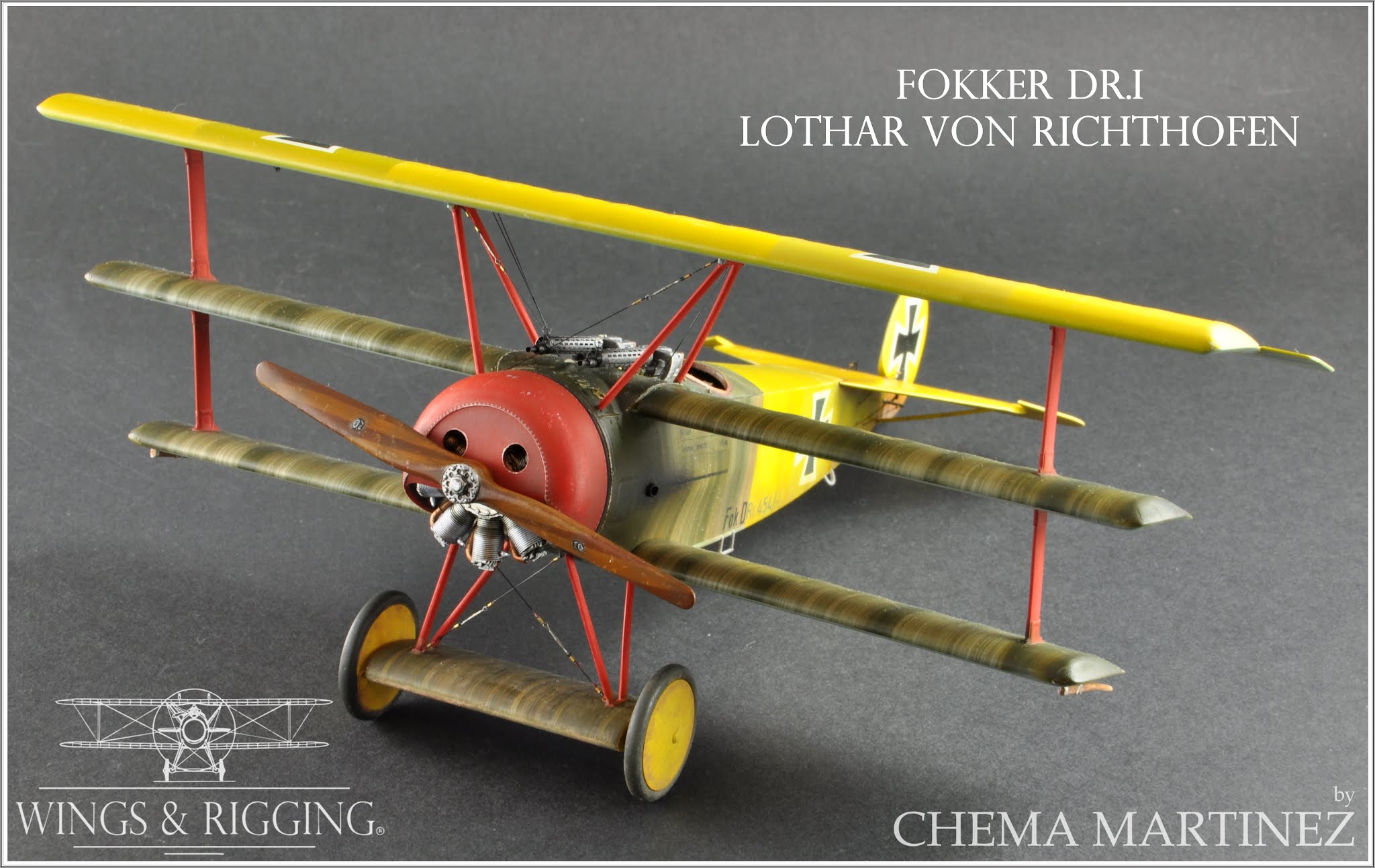
FOKKER Dr.I LOTHAR VON RICHTHOFEN
FOKKER Dr.I LOTHAR VON RICHTHOFEN “A Different Shade of History” A 1/32 scale model built from a kit that’s already more than a decade old. It was great fun to assemble, and I really enjoyed enhancing it both from scratch and with added details in photo-etch, resin, and 3D-printed parts. The painting process was quite a challenge, combining traditional paintwork with decals in some areas of the camouflage. Yellow is not the easiest color to handle, but I’m very pleased with the final result. The crosses were painted using masks, which gives the model a more realistic finish. I chose this particular scheme to step away from the Baron’s typical red and do something different. Even so, his famous red triplane remains on my list of future projects — a small tribute I’d love to create. Hope you like my version of this aircraft. FOKKER Dr.I LOTHAR VON RICHTHOFEN FOKKER Dr.I LOTHAR VON RICHTHOFEN FOKKER Dr.I LOTHAR VON RICHTHOFEN FOKKER Dr.I LOTHAR VON RICHTHOFEN FOKKER Dr.I LOTHAR VON RICHTHOFEN “I chose this particular scheme to step away from the Baron’s typical red and do something different” — Chema M.